


Dalibor Rohac is the director of research at GLOBSEC. His book Unshackled: How Economic Growth Can Defeat the World’s Dictators is out now from Bloomsbury. You can listen to Dalibor on the Older/Wiser Podcast from The Next Move and find him on X at @DaliborRohac.
There are many reasons to be concerned about US-led alliances, and the future of America itself. But there is also ground for optimism. All the main drivers of our decline—from the zero-sum view of our relations with allies, through NIMBYism and souring on open immigration policy, to the breathtaking kleptocracy of the Trump era—are matters of choice.
Bad choices can be undone—if voters and our political class change their minds. That capacity is a real comparative advantage of open societies over unfree ones. In 2015, Greece’s Syriza coalition took power on a platform of wholesale rejection of the fiscal consolidation that the country needed. It then presided over exactly that consolidation, cutting the debt-to-GDP ratio by almost 50 percentage points from nearly 200%.
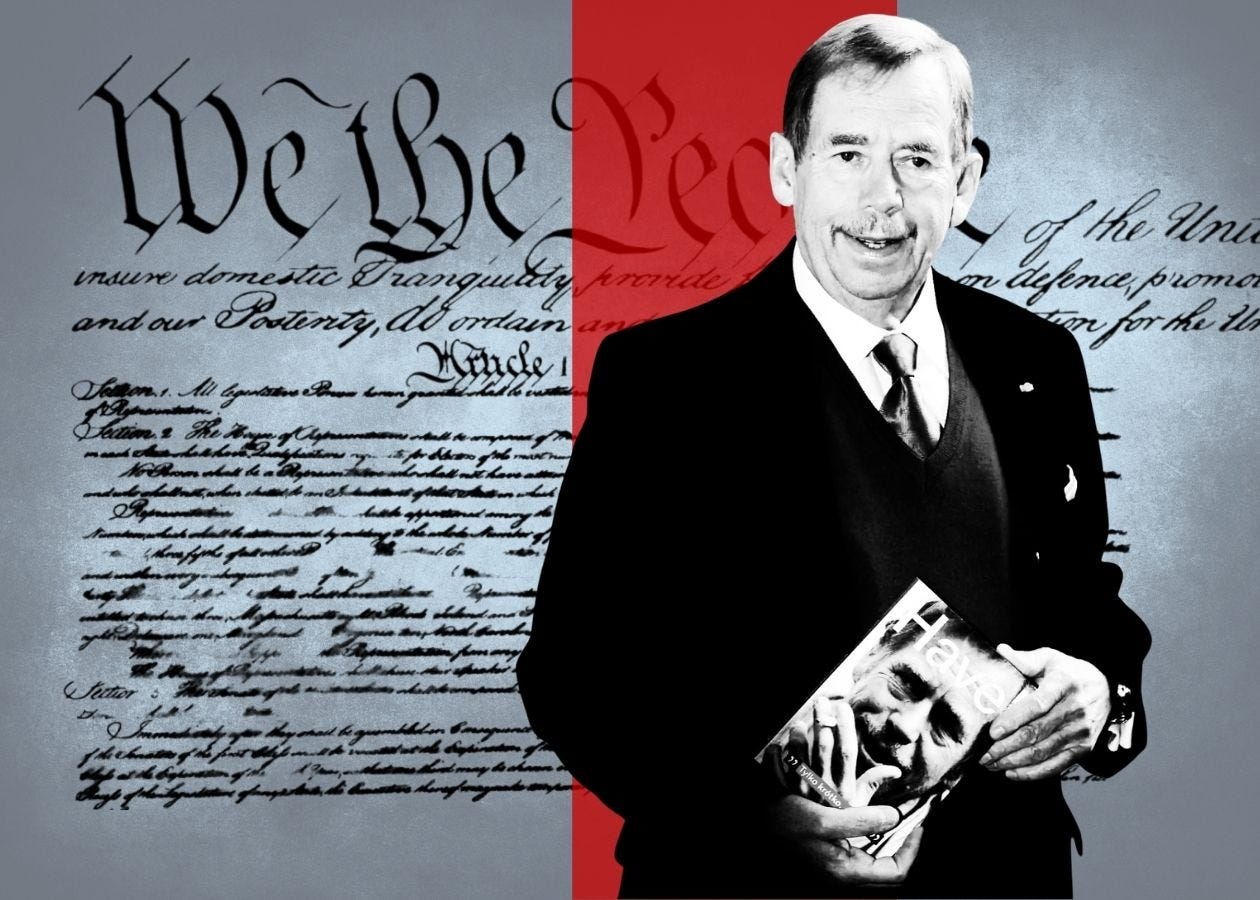
Following the fall of communism, Václav Havel entered Prague Castle believing NATO ought to be dissolved alongside the Warsaw Pact. Within months, he recognized the idea as a dead end and helped lead his country into the alliance. Free societies, the Slovak political scientist Matúš Halás argues, simply course-correct far better than their unfree rivals.
What I signed up for when I became a US citizen some years ago was not a set of policies or some nebulous “American dream,” but a constitutional order built by people who assumed their successors would be fallible and that course correction would be needed. That assumption has been vindicated more often than anyone would like. The same country that interned its own citizens, and took nearly two centuries to make its founding promises available to African Americans, is also the only great power in modern history that has repeatedly turned around and said, in public and on the record, that it had been wrong.
As long as the United States maintains its ability to change course—through open public discussions, free elections, and an engaged and informed electorate—it can get itself out of any hole, no matter how deep.
What exactly needs correcting? First and foremost, the collapse of American power, hard and soft. From the ill-thought-out war of choice with Iran, with no endgame in sight, through unforced confrontations and trade wars with allies, to the cozying up to the world’s dictators, the United States comes across as being both erratic and predatory – and also surprisingly ineffectual at achieving its goals.
Whatever survives of NATO on paper, the trust in America that once made this alliance, and others, an effective fighting force has been largely exhausted.
ICYMI: Hear more from Dalibor on the Older/Wiser Podcast

At home, the picture is no better. Notwithstanding the relentless stream of AI-related innovation, there are questions about the future of America’s economic leadership. The federal budget is on a decidedly unsustainable path, and expressing concerns about it comes across as desperately démodé.
Meanwhile, cuts to basic research—the National Science Foundation, National Institutes of Health, or NASA—coupled with an unfriendly attitude towards foreign students and researchers, bode ill for the nation’s future as the most dynamic and innovative society on the planet. Never mind that in a typical year, the United States earns more from education services sold abroad than from natural gas and coal combined.
To be sure, not everything the current administration has done is vandalism. Prior to the dismantling of USAID, the aid industry had its problems. The Pentagon, too, is overdue for an overhaul, and the Secretary of Defense Pete Hegseth deserves credit for taking small steps to integrate drone and counter-drone systems, with their fast innovation cycles, into US inventories.
Most importantly, none of the policy mistakes is terminal if the corrective machinery still works. America has survived long stretches of bad policy before, because voters punish failure and political entrepreneurs offer something better. Sometimes, the U-turn comes from the same leadership that drove into the ditch.
But democratic self-correction is not automatic. It is a corollary of institutions that must be kept in working order. Today, peaceful transfers of power, independence of criminal prosecutors, or loyalty of legislators to their branch of government (as opposed to the president) are all being questioned.
In 1961, Robert Strausz-Hupé, William Kintner, and Stefan Possony wrote that the overwhelming priority of American grand strategy ought to be the preservation of the American political system, rather than defense of territory. “Perhaps the root weakness of democracy,” they added, “is the reluctance to gauge the full measure of the perennial and ever-recurring threat to its very existence—the very precariousness of freedom.”
That insight, articulated in the context of the Cold War, appears even more salient as a politically feckless United States confronts a new generation of geopolitical adversaries. The policy agenda which I outline in my book Unshackled is not beyond American capacity—deficit reduction, a supply-side politics that lets the country build housing, energy, and infrastructure again, an immigration system that competes for talent instead of repelling it, a public sector capable of moonshots, and a creative, open trade policy to build broad international coalitions.
That policy agenda, however, needs advocates. And those must work in a political system in which winning the argument still means something. As a result, the most important task that Americans have as they think about strategy for the 21st century is to keep the republic alive.
More from The Next Move:
AfD: Three Lessons for America From the German Far Right’s Victory

On catch-all politics, communism, and the failure of the moderates.
An Orbán Man, Now Working for China

The tale of Foreign Minister Péter Szijjártó is a tale of our (tawdry) time.
.
