


Evan Gottesman is the director of communications and special projects at the Renew Democracy Initiative and managing editor of The Next Move.
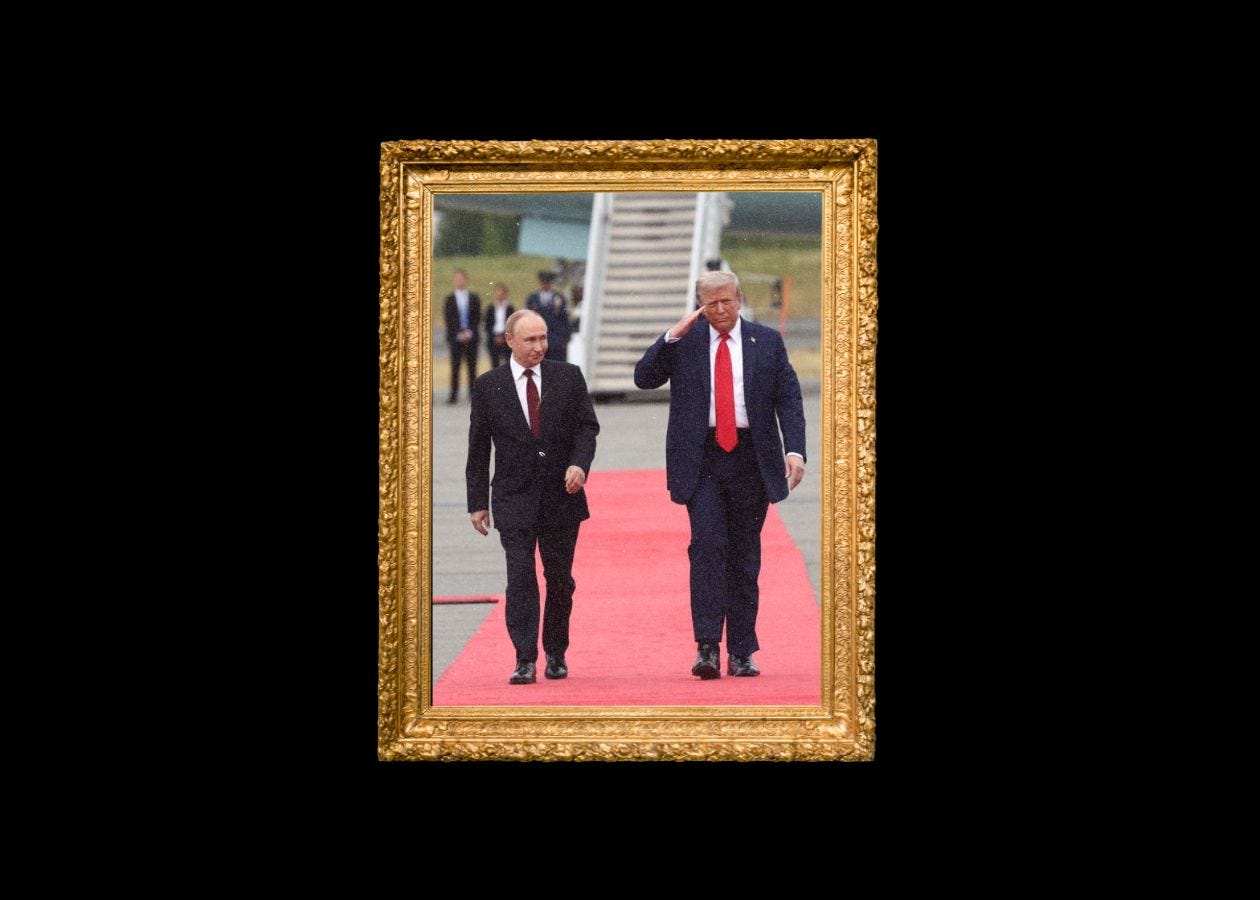
Earlier this year, Donald Trump made some additions to the White House Palm Room: two photos of himself with autocratic leaders; one alongside Xi Jinping, the other with Vladimir Putin. The picture of the president with Putin, a memento from the Russian dictator’s 2025 Alaska visit, was placed above a photograph of Trump’s own granddaughter. Trump has since taken down the picture of his grandkid, but Putin is still there.
Trump’s admiration for foreign authoritarians is shared by Hasan Piker, the influential political streamer who’s staged frequent interventions in Democratic primaries. Piker has interviewed numerous successful primary candidates on his stream, including Darializa Avila Chevalier, Chris Rabb, and Abdul El-Sayed. He praises Mao Zedong as one of the greats and dresses like him too. Piker even has a Chinese flag positioned prominently in the background of many of his streams.
Trump and Piker aren’t the first American public figures to do a little pro-dictator interior decorating. In the early twentieth century, the writer H.L. Mencken hung an autographed portrait of Kaiser Wilhelm II on the wall of his Baltimore bedroom. He fantasized about the German emperor conquering the United States, and thought the country would be better for it.
Mencken submitted his pro-Prussian fan fiction to the Atlantic, which turned him down. But Americans who daydreamed about dictators would find a wider platform just a few decades later amid the ideological competition of the Cold War.
In that era, there were conservatives who embraced right-wing authoritarians as more than just unsavory partners of geopolitical convenience. William F. Buckley Jr. wrote effusively about Francisco Franco, describing him as an inheritor of “the great Christian monarchical Spain of the period of the Conquests;” “an authentic national hero,” who “above others had the combination of talents, the perseverance, and the sense of righteousness of his cause to wrest Spain” from “Marxists and nihilists.”
Buckley’s National Review identified the generalissimo as “a part, an integral part, of Western civilization.”
On the opposite end of the ideological spectrum, Angela Davis, the left-wing black activist, was drawn to the Soviet Union over its nominal stand for racial equality. Davis criss-crossed the communist bloc, ostensibly championing America’s downtrodden. Standing beside despots like East Germany’s Erich Honecker and Cuba’s Fidel Castro, she ignored the downtrodden living under their one-party regimes.
Today, we have Trump and Piker, and not only them: Tucker Carlson and Candace Owens extol Russia’s supposedly traditional values before online audiences numbering in the millions. Legions of social media influencers jet off to the UAE and fawn over its opulence, making no mention of the human misery at the foundations of Dubai’s glamorous skyscrapers.
More often than not, these dictator defenders are projecting. They find (or claim to find) something in oppressive systems that is wanting in America—a strong leader, a path back to a glorious past, or perhaps a road toward the utopian horizon. As journalist Lincoln Steffer, fresh from a visit to Soviet Russia, wrote to a friend: “I have seen the future and it works.”
Dictatorship, of course, does not work—not for the countless people who are disenfranchised under non-democratic regimes.
The United States, for all of its many problems, has a remarkable capacity for self correction. I’m not much one for quoting Bill Clinton these days, but he had it right when he said that “there is nothing wrong with America that cannot be cured by what is right with America.” Every great advancement in US history has been a realization of a hitherto unfulfilled promise from our founding. We have never needed to emulate a Xi, a Putin, or a Franco, and we should have the confidence to reject those who say that we do.


“We have never needed to emulate a Xi, a Putin, or a Franco, and we should have the confidence to reject those who say that we do.”
We should be so lucky. Instead, our dictator comes in the form of Trump! He’s not just a despicable fascist, he’ll most likely bankrupt this nation within a year!
Trump embraces right wing dictators like Putin and now Communists like Kim Jong Un. He’s not fussy.