


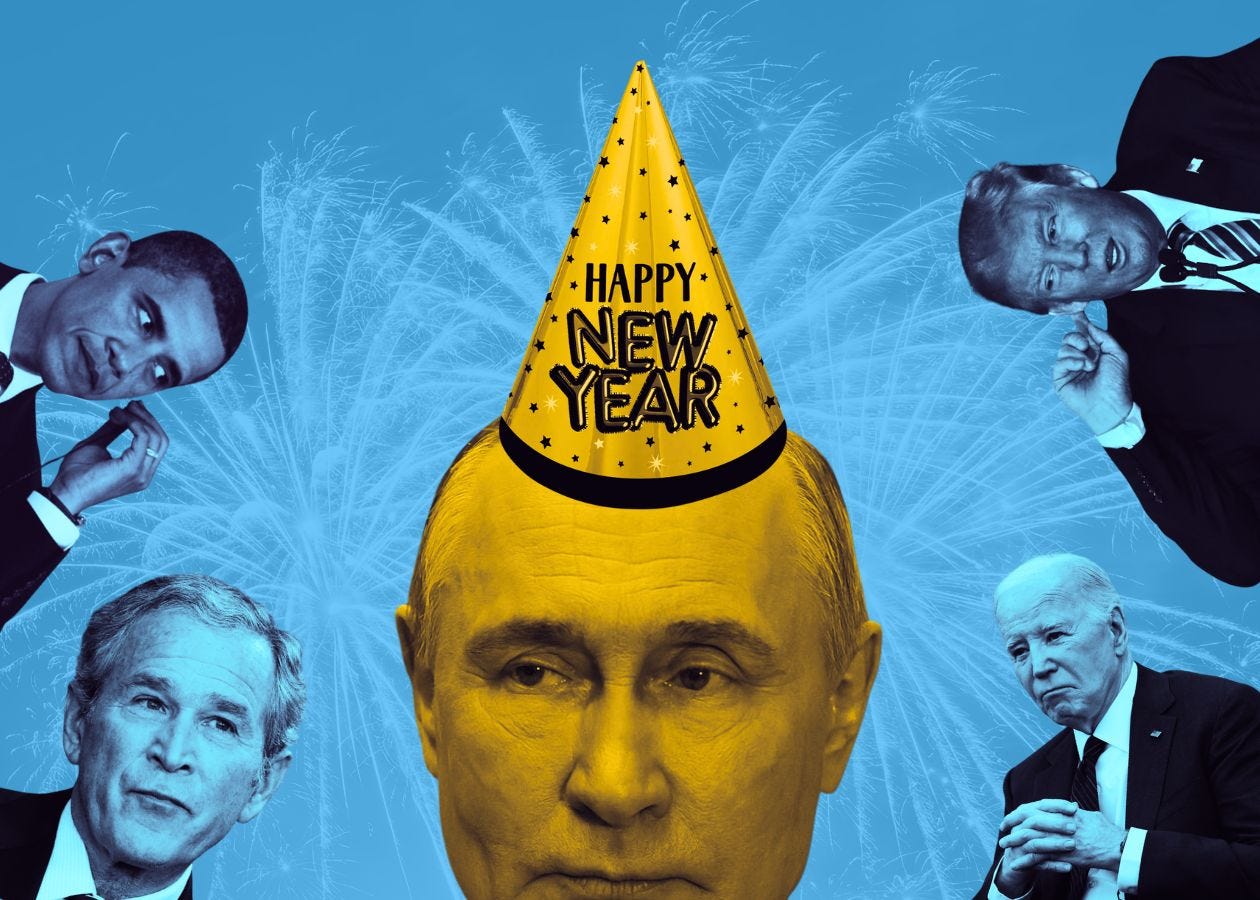
I have a New Year’s resolution for you.
In 2026, I want you to trust dictators.
On the surface, it may seem like a strange thing coming from an advocate of freedom. Yet it’s my experience as a political dissident in Russia that informs this very recommendation.
Last week the National Security Archive released the transcripts of meetings between then-President George W. Bush and still-President Vladimir Putin, made public as the result of a Freedom of Information lawsuit.
The files go back nearly twenty-five years, and their contents are revealing.
Had President Bush and other American leaders paid closer attention to the imperial master plan Putin was articulating a quarter century ago, they might have been able to thwart the invasions of Ukraine and Georgia.
Consider this comment from Putin during a June 2001 summit in Slovenia.
…Russians gave up thousands of square kilometers of territory, voluntarily. Unheard of. Ukraine, part of Russia for centuries, given away. Kazakhstan, given away. The Caucasus too.
In other words, Ukraine is Russian property that Moscow was cheated out of. Bush never disputes Putin’s revisionist account of the collapse of the Soviet-Russian Empire.
In another newly-unveiled transcript from April 2008, we see Putin take an even more assertive tone with Bush. During a meeting at Putin’s Black Sea palace in Sochi, the Russian dictator affirms that:
[Ukraine] is not a nation built in a natural manner. It’s an artificial country created back in Soviet times.
And what if that upstart ex-colony, the “artificial” nation of Ukraine, were to join NATO?
Putin is about as blunt as he can be, telling Bush:
Russia would be creating problems there [in Ukraine] all the time.
(Russia, for what it’s worth, was already creating problems in Ukraine in 2008 with blatant political interference).
Four months later, Russia invaded Georgia—a trial run for the war in Ukraine.
Six years later, Russia invaded eastern Ukraine and annexed Crimea (in that 2008 Sochi meeting, Putin had reminded Bush that Ukraine’s east was land “obtained…from Russia”).
Fourteen years later, Russia launched a brutal attack against the remainder of unoccupied Ukraine.
Days before the all-out assault, with Russian troops massed along the Ukrainian border, Putin delivered a meandering, ahistorical lecture on national television, repeating the same line he relayed to George W. Bush about Ukraine’s supposed status as an “artificial country.”
See what I mean about listening to dictators?
More from The Next Move:

We might forgive some of Bush’s early missteps because Putin was a relative unknown at the start of the twenty-first century. Yet the Russian regime’s intentions should have been unmistakable by the end of Bush’s tenure in office.
Bush’s successors have fewer excuses. Barack Obama saw the war in Georgia and still pursued a shameful “reset” in relations with the Kremlin. Joe Biden saw eight years of war in Ukraine and still slow-rolled life-saving military aid to Kyiv over manufactured fear of “escalation.”
And don’t get me started with Donald Trump.
We all hoped that Russia would change with the end of the Cold War. But the new bosses in Moscow quickly slammed the window of opportunity shut. In 1994, Boris Yeltsin took to war to prevent Chechen independence, firmly putting Moscow back on its traditional path of conquest and aggression. Putin made this clear from the beginning of his reign. Successive American presidents and European leaders closed their eyes and covered their ears.
Tyrants often lie about what they’re doing in the present, but they are quite open about their future plans. Aspiring autocrats were laying their blueprints out in the open as early as 1925, when a now-infamous Austrian published Mein Kampf. Nondemocratic rulers are weak—they need to inflate their stature to match their democratic counterparts and placate hungry publics. So they announce ambitious plans with a remarkable degree of transparency.
There’s a maxim that when someone tells you they want to kill you, you should believe them. That wisdom is very apt when it comes to authoritarians. In the New Year, trust the despots, demagogues, and dictators when they tell you what they are going to do.
More from The Next Move:
America’s Biggest Post-9/11 Failure Is Not What You Think

US leaders made strategic errors dealing with Russia after September 11. Their mistakes have deadly echoes in the present.
The Moscow-Mar-A-Lago Hotline

Recognizing a pattern: Putin calls, America blinks, and Zelenskyy leaves empty-handed.
The indispensable journalist Masha Gessen wrote this (shockingly prescient) primer after Trump's election in 2016:
'Autocracy: Rules for Survival'
"Rule #1: Believe the autocrat. He means what he says. Whenever you find yourself thinking, or hear others claiming, that he is exaggerating, that is our innate tendency to reach for a = rationalization. This will happen often: humans seem to have evolved to practice denial when confronted publicly with the unacceptable. Back in the 1930s, The New York Times assured
its readers that Hitler’s anti-Semitism was all posture. More recently, the same newspaper made a telling choice between two statements made by Putin’s press secretary Dmitry Peskov following a police crackdown on protesters in Moscow:
“The police acted mildly—I would have liked them to act more harshly” rather than those protesters’ “liver should have been spread all over the pavement.” Perhaps the journalists could not believe their ears. But they should—both in the Russian case, and in the American one. For all the admiration Trump has expressed for Putin, the two men are very different; if anything, there is even more reason to listen to everything Trump has said. He has no political establishment
into which to fold himself following the campaign, and therefore no reason to shed his campaign rhetoric.
On the contrary: it is now the establishment that is rushing to accommodate him—from the president, who met with him at the White House on Thursday, to the leaders of the Republican Party, who are discarding their long-held scruples to embrace his radical positions...
To begin jailing his political opponents, or just one opponent, Trump will begin by trying to capture members of the judicial system. Observers and even activists functioning in the normal-election mode are fixated on the Supreme Court as the site of the highest-risk impending Trump appointment. There is little doubt that Trump will appoint someone who will cause the Court to veer to the right; there is also the risk that it might be someone who will wreak havoc with the very culture of the high court. And since Trump plans to use the judicial system to carry out his political vendettas, his pick for attorney general will be no less important. Imagine former New York Mayor Rudy Giuliani or New Jersey Governor Chris Christie going after Hillary Clinton on orders from President Trump; quite aside from their approach to issues such as the Geneva Conventions, the use of police powers, criminal justice reforms, and other urgent concerns."
Chilling. Infuriating. And brilliantly insightful.
It also applies to the current resident dictator in the White House.
I wish everyone would read this. Every freedom-loving person in America and elsewhere needs to take heed.