


Photo: Chris Lawson, Renew Democracy Initiative Ukraine leadership delegation, March 2026
Editor’s Note: The Renew Democracy Initiative—publisher of The Next Move—is in Ukraine! We’ll be sharing daily dispatches from our delegation. Premium subscribers will receive each Ukraine Dispatch 24 hours before anyone else. Be the first to get on-the-ground news from the frontlines of freedom by upgrading to join our premium subscriber community today! All proceeds go to support the work of the Renew Democracy Initiative, including humanitarian assistance to communities in Ukraine.
Uriel Epshtein is the CEO of the Renew Democracy Initiative, which publishes The Next Move.
I can’t tell you where I’m headed.
I’m writing this from the bus. After spending the past couple of days in Kyiv, Ukraine’s capital, we’re turning east. However, the name of the city we’re going to will have to remain secret, at least until we’ve left.
There have been inspiring blips of normalcy throughout the journey, but this country is still at war.
Our next few days will be particularly sensitive.
Allow me to explain.
Premium subscribers received this entire Ukraine Dispatch a day before everyone else. If you are not yet a member of our premium subscriber community, you can upgrade to be the first to receive updates from our Ukraine delegation.
Ultimately, our delegation will end up in Kharkiv. It’s Ukraine’s second-largest city. But we’re not going to be staying over in Kharkiv.
If you look at a map, you’ll see that Kharkiv is located right up against Russia. The outskirts of the municipality are just 13 miles from the border. This means that people living there take the brunt of everything that Moscow’s forces are throwing at Ukraine.
Because of the precarious situation, we’re going to have to commute from a third location, another city located a couple of hours’ drive from Kharkiv. In order to protect our group and our colleagues, I’m going to refrain from disclosing the name of this city.
Our security coordinator, the government ministers we’ve chatted with, “Arkadiy” (the Azov commander I met on Monday), and the mayor of Kharkiv himself have all advised us that overnighting in the city proper would bring unnecessary risk to our group.
This certainly complicates our plans. We’re taking other precautions too. I didn’t think that procuring bulletproof vests and faraday boxes was part of the job description when I signed up to run a non-profit. But here we are.
Yet being a visitor still is a luxury. Truth be told, our local hosts have gone to great lengths to keep us safe. Meanwhile, even though Russia has destroyed a quarter of Kharkiv’s buildings, hundreds of thousands of people continue to live there. They put up with the danger we were advised to avoid every single day.
This is why the bulk of RDI’s aid to Ukraine—roughly $10 million of our $15 million raised—has been committed to the Kharkiv area. Many organizations are doing admirable work supporting refugees, but someone also needs to ensure that Ukraine will be a viable nation the day after the war rather than a depopulated wasteland.
As we continue on, I notice more and more military vehicles taking up the road. We’re clearly getting closer to the actual military front. I watch convoys of trucks painted in olive drab, tarps shielding their cargoes from the elements—and from prying eyes.
There are other signs of the war. Palatial homes juxtaposed against craters where missiles and kamikaze drones exploded.
Meanwhile, the sky is empty. This is especially jarring for someone who lives in the DC area. There are choppers constantly ferrying officials around Washington and its environs. My house is on the flight path of Reagan National Airport, meaning I hear the roar of jet engines during all hours of the day.
Not so in Ukraine. It’s too dangerous for routine flights and even most official travel with the frequent Russian bombardments. So it came as a surprise when, right before leaving Kyiv, I caught two helicopters flying off into the distance. I was having a private meeting with some military officers.
One of them explained. “They’re picking up the most badly injured soldiers… the ones who wouldn’t survive without being evacuated like this. That’s one of the only things our pilots will risk flying for.”
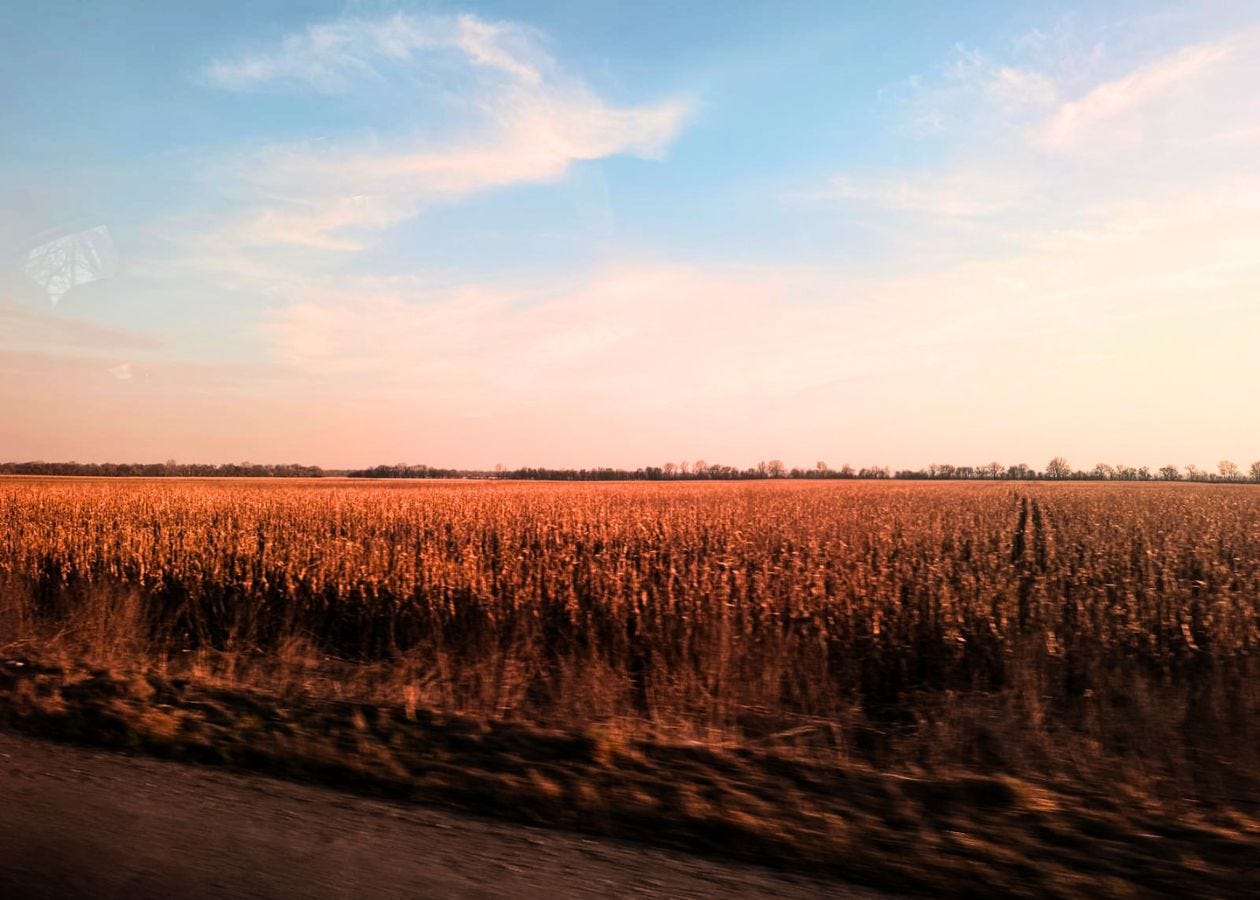
Speaking of the sky: The natural landscape I’m watching from our bus is an imperfect reflection of the Ukrainian flag. In peak season, clear blue skies over shimmering wheatfields make it clear where Ukraine got the inspiration for its national banner.
Today, it’s slightly overcast, and the crops are a little more grey than gold. Yet every so often, the clouds will break and I’ll see the contours of the flag.
P.S. Because of the situation in Kharkiv, it looks like a dispatch will not be in the cards for tomorrow. I’d wanted these dispatches to be truly daily, but I’ll make it up to you!


Thank you for your courageous reporting and incredible work you are doing for Ukraine.
Than kyou Uriel