


Masih Alinejad is an American-Iranian women’s rights activist and journalist. She is a Frontline Fellow at the Renew Democracy Initiative (publisher of The Next Move), the founder of My Stealthy Freedom and United Against Gender Apartheid, and the co-founder of the World Liberty Congress. The Iranian government has targeted Masih in multiple kidnapping and assassination plots on US soil.
In 2009, millions of Iranians poured into the streets during the Green Movement to protest the re-election of Mahmoud Ahmadinejad. They carried banners and placards calling for a fair vote. The Islamic Republic answered those peaceful protests with baton charges, bullets, mass arrests, show trials, executions, and long prison sentences.
The regime survived but that cycle of resistance and repression has been repeated a number of times. Each successive episode was sparked by a specific grievance before rapidly morphing into a referendum on a system that is beyond reform.
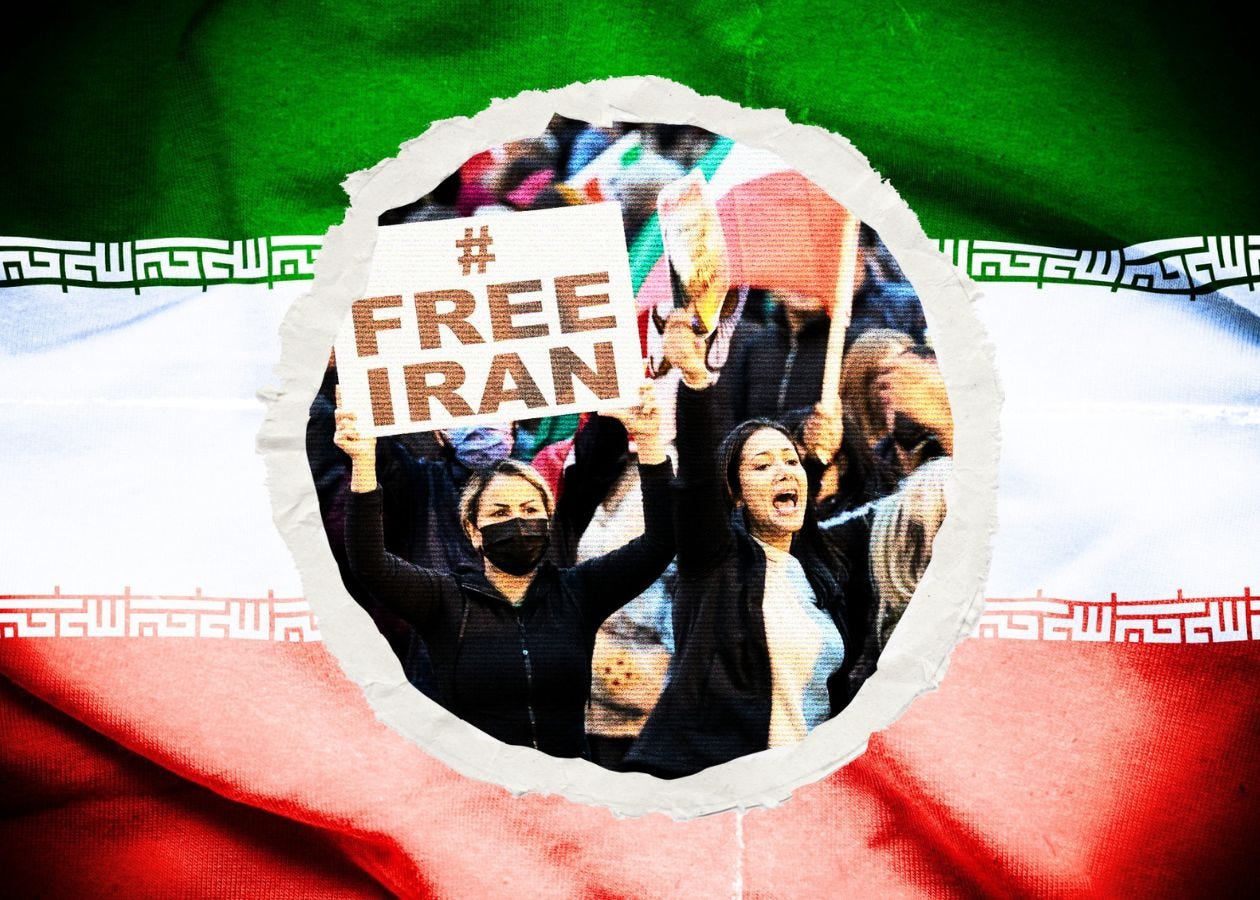
Today, a new wave of protests—the largest since the 2022 “Woman, Life, Freedom” uprising—is rocking the country. The Islamic Republic has responded with bullets. Police have opened fire on unarmed protesters, killing more than 45 people and injuring hundreds. The regime has imposed a nationwide digital blackout and cut phone lines in an attempt to rupture the Iranian people’s connection to the rest of the world. In the city of Ilam, in western Iran, security forces entered a hospital to hunt for dissidents, firing their guns, using tear gas, and assaulting people with batons.
Nearly sixteen years after the Green Movement, we are witnessing the fifth major wave of anti-regime protests. Workers, students, women, and activists have been through previous protests before. Despite seeming failure and the punishments, they never gave up. Free people choose freedom.
This is why Washington’s choices matter.
In 2009, President Barack Obama made the mistake of staying mute as the regime crushed protesters Instead of supporting the people, he wrote secret letters to Ayatollah Ali Khamenei, the Islamic Republic’s supreme leader, because he wanted a nuclear deal.
In 2022, Obama expressed regret for not offering stronger support for the Green Movement. Yet the same strategic assumptions that informed Obama’s misguided policy persisted under the Biden administration, most visibly by granting the regime access to billions of dollars in sanctions relief at a time when it was not only intensifying domestic repression, but also carrying out transnational assassination plots against dissidents (including this author) and US officials on American soil.
More from The Next Move:

That mixed track record may have lulled the Islamic Republic into believing it could continue to get away with murder after Donald Trump returned to office last year. If the ayatollahs assumed that the White House was too busy with Ukraine, Venezuela, and Gaza to pay attention to the most recent protests, they were in for a rude awakening.
Rather than keeping silent, President Trump threatened to intervene if the regime cracked down violently on the protests. He signaled that he is not going to treat Iranian protesters as inconvenient background noise while chasing a “grand bargain” with Tehran.
“If Iran shots [sic] and violently kills peaceful protesters, which is their custom, the United States of America will come to their rescue,” the president posted on social media. “We are locked and loaded and ready to go.”
Yesterday, Trump doubled down on his threat, reporting that “I have let [the regim] know that if they start killing people, which they tend to do during their riots … we’re going to hit them very hard.”
Trump’s post has emboldened the protesters (whom he’s described as “brave people”) who initially took to the streets to complain about the Islamic Republic’s dysfunctional economy—beset, as it is, by corruption, nepotism and mismanagement.
Indeed, it was shopkeepers and merchants in Tehran’s Grand Bazaar, at Alaeddin Passage and Charsou Mall, the beating heart of the city’s mobile phone and electronics trade, that closed their shops in protest.
That detail matters. The bazaar isn’t just an economic institution in Iran; it’s a political barometer. Bazaaris helped drive the Constitutional Revolution of 1906 and played a pivotal role in the upheavals that culminated in the 1979 Islamic Revolution. When the bazaar closes, it signals a rupture in the regime’s governing coalition.
These merchants are among the first hit when the currency collapses. Their goods are priced in dollars and imported. When the rial collapses, they can’t restock inventory, can’t predict prices, and can’t keep contracts. Commerce freezes because people cannot calculate what anything is worth.
The monetary meltdown is staggering. Iran’s rial has hit repeated record lows on the open market, with reports of prices falling to as low as 1.47 million rials to the dollar in early January.
With inflation sitting around the 40% range (and higher by some measures) this is a crisis that had been long in coming. The rial’s sharp deterioration accelerated after the June 2025 Iran-Israel conflict, the so-called “12-Day War” that saw Revolutionary Guards (IRGC) commanders killed and nuclear enrichment facilities pulverized.
But that war was a catalyst, not the root cause. The deeper problem is structural: The Islamic Republic runs an economy designed for patronage, not prosperity. Khamenei’s the richest man in Iranian history and uses that wealth to not only spread terror but buy off peace within his regime. The system is kept afloat by hidden subsidies and opaque accounts; when revenue falls short the regime prints more money. That pushes inflation higher, weakens the rial further, and drives more people into dollars, gold, and anything that doesn’t evaporate overnight.
This crisis is therefore political and not financial. The regime is resorting to force but that only delays change. Repression cannot restore legitimacy.
Hemingway had a line about going bankrupt: “gradually, then suddenly.” Dictatorships die the same way: They rot slowly, and then collapse suddenly. After each wave of protest, we are getting closer to the sudden part
What is Washington to do? President Trump has so far not fallen for the fantasy that quiet diplomacy will somehow reform the Islamic Republic. The swift removal of Venezuelan dictator Nicolas Maduro over the weekend demonstrates that the US is not afraid to eject entrenched despots from their thrones.
Instead, the White House should take three simple steps.
First, the administration can get Elon Musk to provide more Starlinks for Iranians. Internet access is an engine for democratic resistance; this is why the Islamic Republic and other dictatorships restrict it. Mobilizing Starlinks will allow Iranians to share news, document atrocities, and organize resistance.
Next, the US should expel Iranian diplomats from the country and cancel their visas (Iran maintains a mission to the United Nations in New York).
Lastly, the United States should warn regime officials that anyone ordering the killing of protesters will be pursued and dealt with in the same manner as IRGC commander Qasem Soleimani during Trump’s first term or Nicolas Maduro this past weekend.
Iranians are making clear that they are not bargaining to reform the regime. They do not want one set of demagogues traded for another. They want a new form of government, based on democracy and rule of law. They are demanding a regime change.
An Iran without the Islamic Republic would guarantee stability for its own people, peace for the region, and greater security for the world anchored in democracy and the rule of law. Beyond words, this moment requires action.
More from The Next Move:
A Foreign Plot. A Test of American Freedom.

Iran tried to murder activist Masih Alinejad in Brooklyn. Her case should rally Americans around our First Amendment freedoms.
Facing My Would-Be Assassins

Iranian dissident and RDI Frontline Fellow Masih Alinejad: The men hired to murder me were convicted. Now the US should stand up to the regime that sent them.

Good luck with that. The president of the US and his cronies don’t care about his own people’s freedom, let alone Iranians’ (who frankly speaking, deserve freedom at least as much as the Americans, too many of whom are allowing their liberties to be stolen).
Your beloved President Trump doesn't care one bit about you or any other Iranian. Take a look at Iraq for a second. When America gets rid of the dictator, it becomes the dictator.