


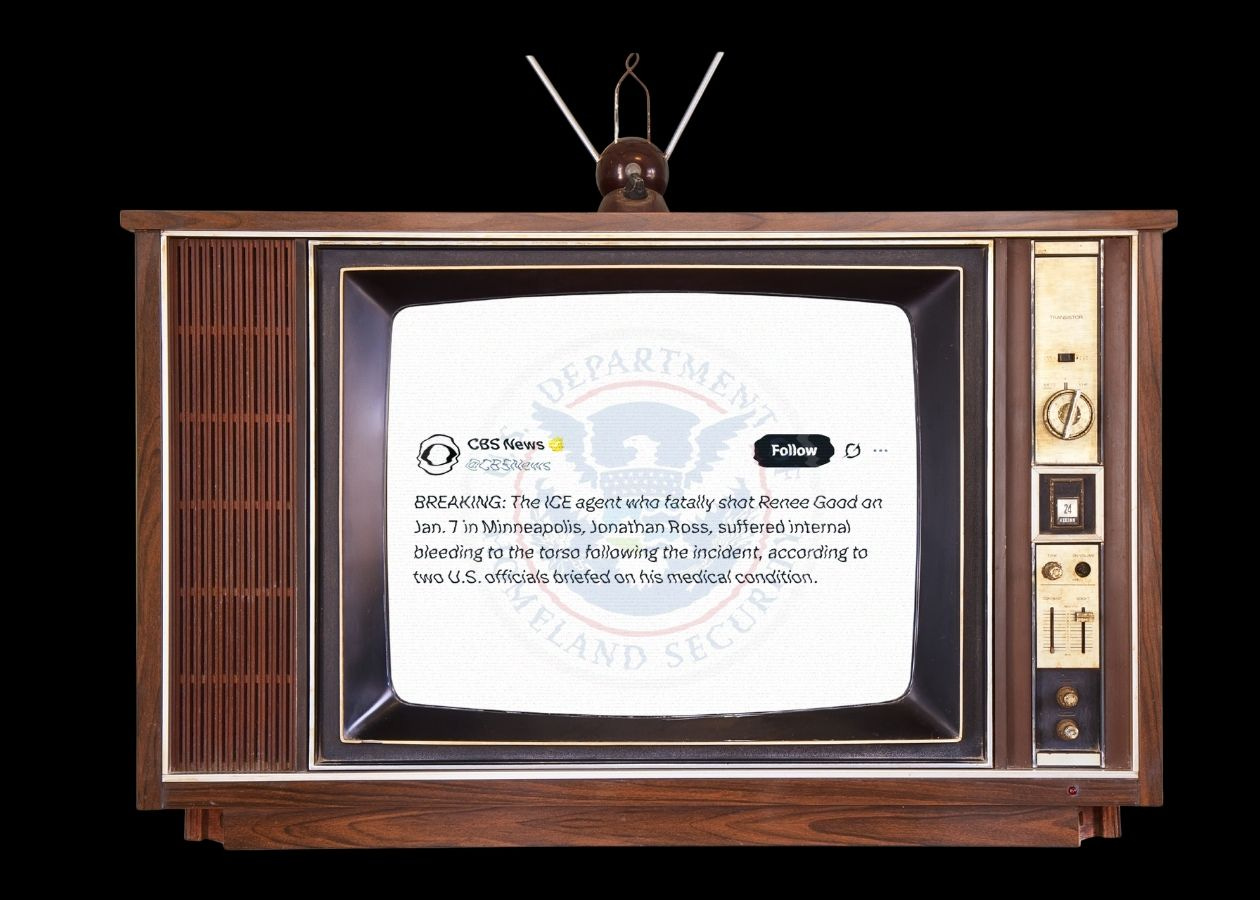
When does a Free Press become state media?
Have a look at his tweet:
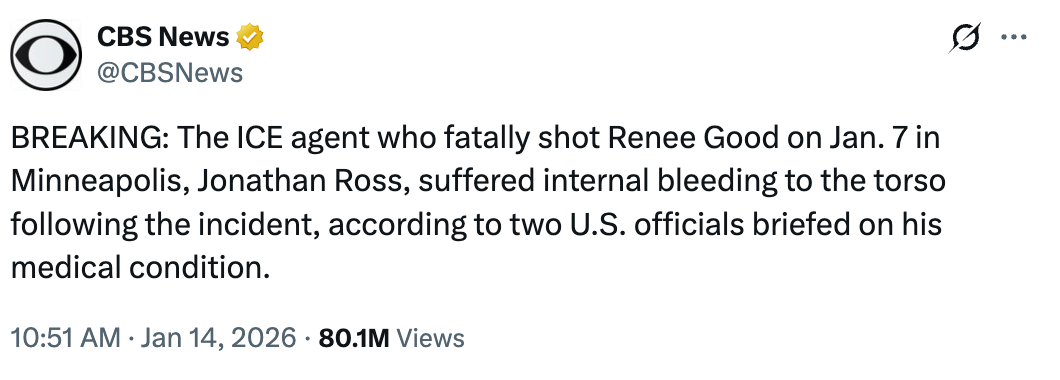
Jonathan Ross, the ICE agent who killed Renee Nicole Good in Minneapolis, “suffered internal bleeding.” No proof. Just the word of some unnamed “US officials.”
Now, plenty of outlets cite anonymous sources. But those sources must be used judiciously. Here’s what the Associated Press has to say about the practice:
When the AP does agree to use anonymous material, reporters must have a good reason. We should provide as specific as possible a description of the source to establish his or her credibility (for example, “according to top White House aides” or “a senior official in the agency directly involved in the discussions”) and, when relevant, describe the source’s motive for disclosing the information.
I would actually be in favor of CBS sharing the comments of those “US officials”—though, as the AP guidelines note, we ought to know a bit more about who they are (the president of the United States and a social media intern at the White House are both “US officials”). It’s important for people to know what their government is saying, all the more so when the government may be lying.
Contrast the CBS post with the way the AP handled the story:
Jonathan Ross, the Immigration and Customs Enforcement officer who killed Renee Good last Wednesday in Minneapolis, suffered internal bleeding to his torso during the encounter, a Homeland Security official told The Associated Press.
The official spoke to AP on condition of anonymity in order to discuss Ross’ medical condition. The official did not provide details about the severity of the injuries, and the agency did not respond to questions about the extent of the bleeding, exactly how he suffered the injury, when it was diagnosed or his medical treatment.
There are many causes of internal bleeding, and they vary in severity from bruising to significant blood loss. Video from the scene showed Ross and other officers walking without obvious difficulty after Good was shot and her Honda Pilot crashed into other vehicles.
The addition of just a few more sentences fills critical gaps in the story. First, we know what agency the anonymous official represents. Next, we know that the official claim is light on documentary evidence and that the government is unresponsive to a further line of questioning on the matter. Finally, we know that it contradicts what millions of people saw in multiple video recordings of the incident.
I would have added three more pieces of information. First, that Ross stepped in front of Ms. Good’s car in apparent violation of ICE training protocols. Second, that within hours of the shooting in Minneapolis, President Trump and Homeland Security Secretary Kristi Noem made statements clearing the federal agent of any wrongdoing in the death of an American citizen. Finally, I would note that the government is investigating Good’s widow, and that at least three federal prosecutors have resigned over that probe.
More from The Next Move:

This is what it means to tell a complete story. It’s not editorializing. An informed reader can decide what conclusions to draw about the credibility of government claims from the facts presented to them.
Without that context, what CBS is doing is not journalism. It’s publishing a press release for the Department of Homeland Security bearing the imprimatur of a once-respected, nominally-independent media outlet.
Of course, we cannot discuss this abdication of journalistic responsibility without talking about Bari Weiss. In less than half a decade, Bari went from launching her own media startup, The Free Press, to having it acquired by CBS News, where she is now editor-in-chief.
Last month, I penned an open letter to Bari. She had just pulled a 60 Minutes feature on CECOT—the massive Salvadoran prison complex, now a destination for many deportees under the Trump administration. Bari reportedly insisted that the feature was postponed, not cancelled. I gave Bari the benefit of the doubt and asked when we could expect to see the documentary.
I wrote that letter because I was sympathetic to Bari’s ostensible aims when she first launched her own outlet. Going against the grain. Disrupting a stagnant media landscape. These could be good things. I even had a piece published in The Free Press.
But it turns out those qualifiers—”ostensible aims,” “could be good”—were doing a lot of heavy lifting. I have not heard from Bari, nor from anyone else at The Free Press, since publishing my letter. We have not seen the CECOT documentary (not on CBS, at least—a Canadian broadcaster accidentally ran it, and a version leaked online). But we have seen what Bari Weiss stands for.
At Bari Weiss’s CBS, a 60 Minutes feature that passed internal editorial vetting and legal review is apparently not fit for airtime. But the claims of “US officials” run undisputed. I’ll let you decide what to call that kind of media operation—personally, I wouldn’t say it’s a Free Press.
More from The Next Move:
Dear Bari Weiss: From a Russian Dissident

From Garry to Bari: On CBS 60 Minutes, CECOT, and a free press.
I Saw How Russia Killed Media Freedom

Censorship is central to the story of Russia’s descent into KGB dictatorship.
Thank you, Garry, for following up on your original column about Bari Weiss and CBS... and delivering perfectly accurate criticism of their crimes against journalism. As I noted in a comment on that original post, I think you were being too kind. So far, nothing coming out of CBS under Weiss looks like real journalism.
This is straightforward. If there was trauma induced internal bleeding, that would necessitate whole body ct, observation or surgery. If it was a bruise, Tylenol…. This is nonsense, and a 2 minute conversation with any surgeon or er doctor would reveal the lie. So much for due diligence in reporting…